
Garden Pests & Disease Control

The ultimate garden pests. They can take over your plant population or your front lawn in a matter of days, and getting rid of them is not always easy. It’s important to know how to identify and control weeds in order to have a successful growing season.
Caring for your lawn or garden can sometimes seem like a full-time job. In order to raise healthy plants, you’ll need to be on the lookout for insects, animals, and diseases that can cause problems. The most common problem in any garden, however, is the common weed. Weeds can take over a garden or lawn very quickly, choking out the plants and grass and taking over the growing space.
Nobody wants to spray poisons all over or spend hours pulling weeds one by one. The key to eradicating a weed problem is knowing how to identify and remove weeds once and for all.
If you love to garden and take care of your lawn, and you’re looking for help with weed control, you’ve come to the right place. Our articles offer a wealth of valuable information on how to safely and easily remove weeds without hours of effort or harmful side effects. Let us help you help your plants!
Red Spider Mites

Description of Red Spider Mites
These are members of the Tetranychidae Family (ie. related to spiders and crabs rather than insects).
Detection of Red Spider Mites
These are tiny spiders with bristly backs hardly visible with the naked eye. If you are using a hand lens you would be able to see that the creatures have eight legs rather than the six typical of insects. Like most spiders, they spin small webs which are clearly visible on the bottom of leaves, between leaves, over flower buds and between forks of the plant. Small yellow or brown spots (stipples) may also appear on the tops of the leaves. A severe infestation will give the plant a dusty look, the leaves will eventually turn a rusty red color before dropping off. For early detection, it’s worthwhile placing a piece of white paper under the plant or a single leaf and then tapping it. The small mites (about the size of fine sand) are easy to see on the white background as they crawl around.
Control of Red Spider Mites
Spider mites dislike humidity so misting the plant regularly may slow their reproductive rate. Adding a little insecticidal soap and methylated spirits to the water in your mister will also aid in the battle against this most persistent pest. Remove the webs and the spider mites by washing the plant in soapy tepid water, paying particular attention to the underside of all the leaves. For tough plants, a forceful jet of water can be used. Washing will not always remove all the eggs so repeat the treatment every 3 to 4 days until the plant is clear to ensure its success. For severe infestations spraying the plant with acephate or hexakis may be of some help but in order to prevent the contamination of any other plants, it may be best simply to destroy the plant.
Whitefly
Description of Whitefly
Dandruff-liketiny insects with two pairs of wings that are covered in white powdery wax.

Detection of Whitefly
Whiteflies are dandruff-like tiny insects with two pairs of wings that are covered in white powdery wax. Younger stages are wingless and damage the plants severely by sucking out their juices. The adults live mostly on the underside of leaves and especially like newly unfurled leaves. Tapping the plant will cause them briefly to take flight. Once an infestation has been discovered it will quickly spread and you should isolate the plant if this is possible. Foliage will eventually yellow and drop as the infestation strengthens. Like most of these pests, whiteflies excrete a sticky honeydew which could attract a black sooty mold.
Control of Whitefly
Take the plant from isolation into a well-ventilated area, preferably outside and spray the plant with a chemical approved for use in your area, paying particular attention to the undersides of the leaves. An insecticidal soap spray can also be used with relatively little risk, but like most sprays, it will not be particularly effective against the whitefly eggs. Repeat the spraying every two days and when the infestation has retreated, spray every ten days to ensure all whiteflies in different stages of growth are destroyed. For minor infestations, wipe the underside of the leaves with an alcohol-soaked cloth and then rinse with a strong spray of tepid water. Always wash your hands after handling an infected plant to prevent the spreading of their eggs to other plants. This is a serious pest, and by far the best control is to be sure that it is never brought into the house. Be very careful to inspect any new plant brought in, and, if possible, keep it quarantined and under observation for a few days.
Thrips

Description of Thrips
Adult insects are yellow, tan or black
Detection of Thrips
The adult insects move freely around on the plant. They suck plant juices from the leaves, causing pale spots. In a severe infestation, the leaves turn yellow and die. These pests thrive in hot, dry conditions.
Control of Thrips
Minor infestations can be taken care of by a forceful spray of water. If chemical control is needed, you should check with your local agricultural college to find what is legal for use in your area. Both contact and systemic types may be used. Repeat treatment in a few days to ensure success, following the label directions exactly.
Aphids
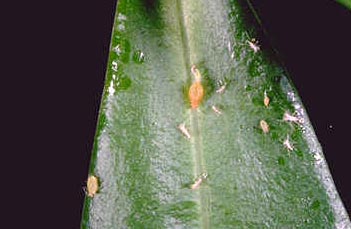
Description of Aphids
Commonly called plant lice.
Detection of Aphids
Check the undersides of leaves, new shoots and buds for an oval-shaped insect which grows to about 3mm long with disproportionately long legs and antennae; some species also have wings. Aphids may be green, pink, brown, white, black, yellow, red or grey. They live in small colonies or groups and often have white “shells” (cast-off skins) scattered among the living insects. Aphids suck out juices from the plants, causing stunted growth, and distortion of buds and leaves which if left untreated will cause the affected area to curl and die. They also excrete a sticky honeydew which could attract a black sooty mold. The more difficult aphids to detect feed from the roots. Although, fortunately, they are unusual on house plants.
Control of Aphids
Remove as many as possible by hand with a soft brush then take the plant and swish it upside-down in a weak solution of soapy water (preferably non-detergent). Be careful not to contaminate the soil with soap and cover the top of the pot with a plastic bag in order to prevent soil from falling out. Swab the leaves with a soapy cloth and then rinse with clear tepid water. A tough plant may be rinsed with the garden hose paying particular attention to the underside of the leaves. For persistent infestations, take the plant into a well-ventilated area, preferably outside, and spray the plant with one of the insecticides that are legal to use where you live. Aphids are becoming resistant to some of the commonly used chemicals, so check with your local garden center or agricultural college.
Pest Control Safety
The post Garden Pests & Disease Control appeared first on GARDENS NURSERY.
Commentaires
Enregistrer un commentaire